
Interjection of Thresholds
The studio aims to create challenging and unconventional "love stories' between a client and designer, questioning the traditional relationships and roles played by both the parties as a 'dreamer' and the 'realiser of the dream'. We are put into the positions of both, being the creator of a dream house for someone else as well as a dreamer of our own. It starts with us being the clients and laying out the program for our dreamhouse through compilation of happy architectural memories which will turn into elements for their ideal house by their designers while simultaneously please another student for whom we'd design their dreamhouse. The context and brief of programs is derived from these 6-8 memories shared by the client, which are their fondest, spatially and geographically situated.
The Brief
The Radical Exteriorisation of a Dream House resulting from a Transactional affair between the Client and designer, where the roles of each are challenged.
THE SITE
The first translation of memory is materialised within a fantastical context, derived from the geographical interpretations embedded in Diana’s recollections. Guided by the studio’s organisational frameworks, a palimpsestic site is constructed, one that reflects her oscillation between observer and participant, and her reading of space as fluid, permeable, and continually shifting. The proposal thus operates between perception and objective reality, exteriorising memory into the voids of the dense city.
The site manifests as an infinite open field that dramatically sinks to accommodate the city as a construct of reality. While the urban grid attempts to assert itself within this staged condition, it begins to fracture at the periphery. The field becomes a spatial theatre where landscape, particularly distant mountains, is perceived through deliberately placed architectural elements. What emerges is a palimpsest between boundless openness and urban constraint, held in productive tension.
Postcards of Happy Memories
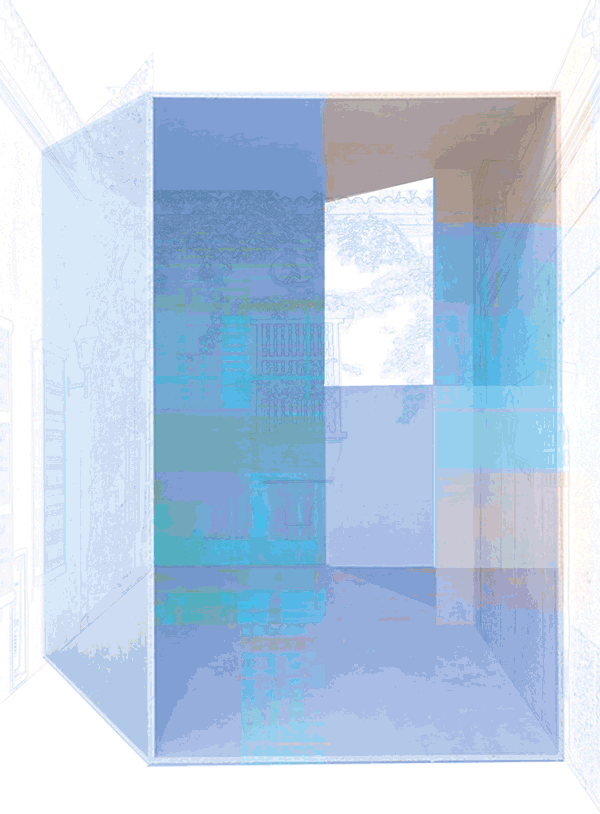
Six postcards, derived from Diana’s memories of happiness, translate lived experience into architectural atmospheres. These memories reveal inhabitation as an ephemeral condition shaped by non-tangible forces: light, movement, and the presence of others, where architectural elements shift in meaning through perception rather than form. Small apertures, extended thresholds, and unreachable ceilings express a recurring desire for reciprocity between inside and outside, rendering space infinite and unstable.
Her experience of space is mediated by altered perception; silhouettes, colour, and coincidence, where objectivity dissolves into ritual. Strangers become temporary participants in these rituals, suggesting a balance between control and emergence. A parallel tension exists between immersion in urban noise and deliberate detachment, both producing freedom and calm. This oscillation between observer and participant is resolved through spatial qualities of vastness, fluidity, transparency, and permeability, enabling a dynamic and fantastical mode of inhabitation.


Radical EXTERIORIZATION///


Interjection of Threshold proposes a radical exteriorisation of the house, interrogating the boundary between domestic inhabitation and the urban fabric. Through client memories the project foregrounds architecture as a shifting negotiation between authorship, ritual, and ownership. Her oscillation between observer and participant produces permeable, fluid spaces, where perception is continually destabilised by external forces beyond individual control. The house thus operates between subjective experience and objective reality, extending itself into the voids of the dense city.
The site is conceived as a palimpsest: an infinite open field that sinks to accommodate the city as a constructed reality. While the urban grid attempts to persist within this staged condition, it fractures at the periphery. Architecture becomes a device through which landscape, particularly distant mountains, is framed and perceived, holding open field and urban constraint in tension. The house adopts the language of the street, interjecting into existing buildings and enabling constant exchange between inside and outside.
Inhabitation unfolds through public rituals - plazas, forums, markets - where domestic acts such as dining are reconfigured as communal events. The house becomes a spatial journey, grounded at its core and gradually detaching tectonically as one moves through it, dissolving into its context while remaining legible. Infrastructure typically concealed within the city: hydroelectric systems, rainwater harvesting, vertical gardens, is drawn into the house and made visible, reversing conventional roles: rituals occupy the exterior, while systems are internalised.
Through this inversion, the house fuses with the street, supporting its infrastructures and exposing hidden urban processes. The project ultimately destabilises the assumed order of architecture, proposing an indeterminate condition where inhabitation, authorship, and form remain unresolved.


The house adopts the language of the street, interjecting itself into existing buildings at multiple points and enabling a constant exchange between outside and inside. Inhabitation is articulated through public rituals—plazas, forums, and markets—where domestic space is extended into the civic realm.
The act of dining becoming communal and colliding with the activities of market
The de-privatization of entering a bedroom (private) space through congregation office space.


The house becomes a journey for her through this constant fluctuation. It solidifies itelf to the ground at the beginning of the journey and as she moves through it, it will detach itself from the ground tectonically. attempting to dissolve into the context but very much present at the same time.
Perception is further manipulated through a façade system that modulates light and colour, producing shifting silhouettes throughout the day and unsettling the notion of a fixed reality. The introduction of vertical gardens reinforces this inversion, reversing conventional assumptions of what belongs inside and outside. Through these strategies, the house becomes a site where systems, perception, and inhabitation continuously reconfigure one another.
The proposal interrogates the existence and agency of infrastructure, both within and beyond the house, destabilising the boundary between what is perceived as public and domestic. Systems typically detached from the dwelling, billboards, electrical cables, streetlights, are absorbed into the architecture, positioning the house as a supporting infrastructure for the city. These systems are rendered visible and experiential: rainwater harvesting, for instance, is articulated through a skylight-gutter detail, allowing the movement and collection of water, normally concealed, to be perceived in real time.


