Permeating Skeletons
Living exceeds function, typology, and the neatness of planning diagrams. The contemporary city claims order, yet fails to reconcile the built and the natural, the public and the private. Nature is parcelled, cities are intensified, suburbs sprawl outward in rings: horizontal, relentless. What is called “dynamic” is often only faster.
The constructed world advances like wildfire. The new is celebrated; the recent past is erased. Change, though inevitable, is being forced, natural withering replaced by accelerated destruction. We uproot memory in the name of urgency. Architecture, bound to pre-defined use and authored individuality, cannot keep pace with a world whose needs are constantly shifting.
The architecture of the future must remember. It must coexist rather than conquer, allowing the natural to infiltrate the built. Given time and ground, landscapes regenerate. We should let architecture yield, adapt, and become permeable.
Function must be provisional. Typology must dissolve. Buildings should change as life does. Architecture can be built with users, not for them, decentralising authorship through systems that enable adaptation, reuse, and regeneration. Control need not be rigid; it can be collective, cyclical, and open-ended.
The future is not a finished form. It is an architecture willing to remain unresolved.
The Radical
An age of a new city begins here. A utopian future, unapologetically proposed. Why not?
Let it look like this>>>
THE SITE
Unsettled Architecture
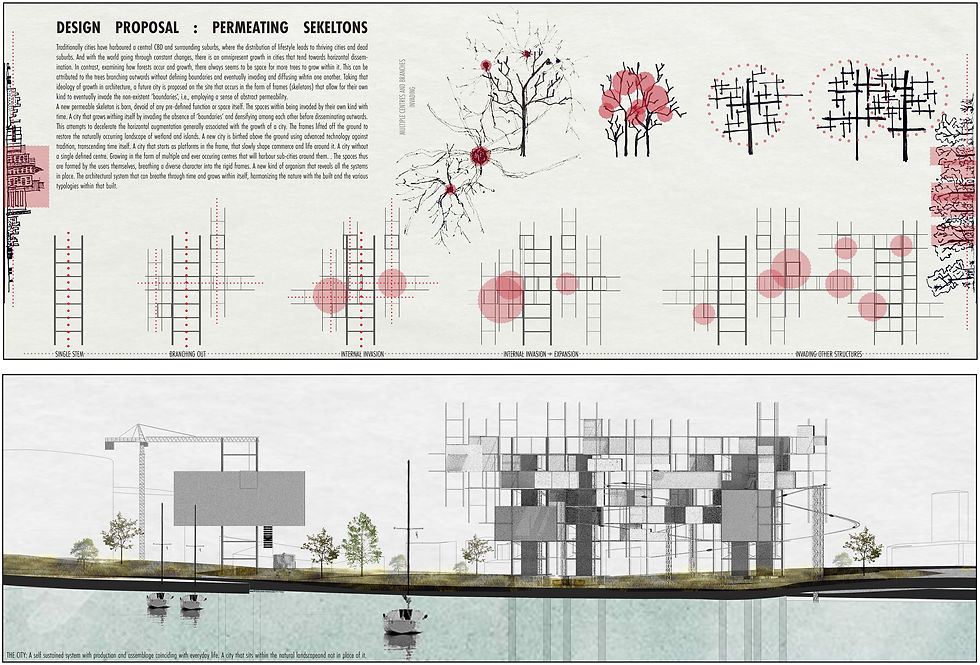
We propose a permeable skeleton: architecture stripped of pre-defined function, liberated from fixed space. Lifted from the ground, the frame returns land to landscape, allowing nature to persist beneath the city rather than be erased by it.
A new city emerges above ground, technologically advanced yet temporally indifferent, opposing tradition not to reject it, but to outlast it. It begins as platforms suspended within a frame, slowly accreting life, commerce, and ritual. Boundaries dissolve. Spaces are invaded, adapted, and re-inhabited by their own kind.
Growth occurs inward before outward. Density precedes sprawl. The absence of borders enables the city to thicken, mutate, and reorganise itself, resisting the habitual horizontal expansion of urban form. Users become authors, shaping space over time and infusing the rigid frame with plural identities.
This is an urban organism - one that exposes its systems rather than conceals them. An architecture that breathes through time, growing within itself, aligning built form with ecology, infrastructure, and inhabitation in a continuous, evolving harmony.
Less footprint. More future. No boundaries. Who is the Architect??
Allegedly “almost a copy” of Constant’s New Babylon, according to a critic I encountered before discovering the project myself. Awareness came later; the affinity remains.

Sited on Kooragang Island, scarred by colonial dredging and industrialisation, the proposed city is lifted from the ground to permit the island’s regeneration. Rather than occupying land, the city hovers, yielding space back to Country.
The urban system operates parasitically, invading itself rather than its surroundings. It subdivides, mutates, and reconfigures in response to changing needs, enabled by prefabricated components that allow continual assembly and disassembly.
Authorship is decentralised. Users become architects, and architecture becomes a system rather than an object: adaptive, reversible, and accountable to time, Country, and use.
Project Status : Perpetual
Construction
Year : 2050
Type : City
Location : Kooragang Island
This project proposes a future city that rejects the centre–suburb hierarchy and its reliance on horizontal sprawl. Instead, it looks to forest ecologies—where growth occurs through overlap, invasion, and densification without fixed boundaries—as a model for urban expansion. A system of elevated frames forms a permeable urban skeleton, devoid of predetermined function, allowing space to be continuously occupied, reoccupied, and transformed over time.
Lifted above the wetland landscape, the city yields the ground back to regeneration while life unfolds above as platforms that gradually shape commerce, ritual, and inhabitation. Growth occurs inward before outward, decelerating sprawl and producing a city without a singular centre—only multiple, shifting ones. Users become authors, infusing the rigid frame with diverse identities, while exposed systems render the city legible as a living organism. What emerges is an architecture that breathes through time, harmonising built form, ecology, and change.